.png)
Kente Cloth Meaning: History, Symbolism, Colors, and How to Wear It


There are fabrics that instantly grab your attention.
Kente is definitely one of them.
Beyond the fabric’s beautiful patterns and colors, lies a very rich history and meaning that stretches far beyond a pretty piece of cloth.
Kente isn’t just pretty fabric.
It embodies Ghanaian history, pride, identity, heritage, and royalty.
Kente has been used throughout history to pass stories and messages along. Different patterns and combinations have different meanings and depict different ideas.
Certain pieces of cloth can be worn to celebrate special occasions. For generations, Kente has been indicative of pride, leadership, and social status.
To that end, there are numerous ways to use Kente in your wardrobe and look fashionable while maintaining the respect owed to Kente.
Where Did Kente Come From?
Kente has historical significance to Ghana.
It is usually associated with the Asante kingdom because in their culture woven cloth was associated with royalty and high social class.
There are other important Kente traditions among the Ewe of Ghana and the surrounding areas.
Because it developed due to the influence of many different cultural traditions, it is important to not consider all Kente as though it has a single origin.
You will come across different explanations about the origin of the cloth.
Among the Asante, one of the famous traditions explains that Kente weaving was inspired by the elaborate ways in which a spider spins its web.
This tradition explains one of the weaving techniques in which weavers use a hidden thread to produce a pattern which, to an untrained eye, looks like random geometric figures.
It is important to consider the cultural tradition and history of Kente, because in reality, it evolved to be one of the finest and most complicated woven art in Ghana.
It is closely related to the social, cultural, and political structure of Ghanaian society.
Why Is Kente Cloth Important?
To know Kente, one must understand that it was never about stylish attire.
There were forms of Kente which were exclusively reserved for the royal class.
The cloth could be worn for social engagements and important ceremonies and particular designs could indicate status or ideas.
The inclusion of various motifs, colors, and patterns can carry deep meaning.
It is this meaning that makes Kente different from other printed clothes.
The geometrical patterns aren't just for aesthetics.
They can have meaning.
The weaver is not simply choosing colors because they look attractive. The combination of motifs, colors, and weaving techniques can carry cultural information.
In this sense, Kente can be understood as a form of visual storytelling.
What Does Kente Cloth Symbolize?
The symbolism of Kente can vary depending on the specific design, cultural context, community, and interpretation.
There isn't one universal meaning for every Kente pattern.
That's important to remember.
Still, many Kente colors and motifs have commonly recognized associations.
Some of the most frequently discussed colors include gold, yellow, green, blue, red, black, and white.
Let's look at some of them.
Kente Colors and Their Meanings
Gold
Gold is often associated with:
Wealth
Royalty
Prestige
High status
Spiritual richness
Its connection with royalty makes gold particularly prominent in many Kente designs.
Yellow
Yellow can be associated with:
Gold
Wealth
Fertility
Prosperity
Brightness
Because of its visual relationship with gold, yellow can also carry associations of abundance and prestige.
Green
Green is commonly connected with:
Growth
Agriculture
Renewal
Life
Forests
Natural resources
These associations make sense within a cultural environment where agriculture and the natural world have historically played important roles.
Blue
Blue can represent ideas such as:
Peace
Harmony
Love
Serenity
The sky or water
Blue often provides a calming contrast to the stronger reds, golds, and yellows found in many Kente designs.
Red
Red is a powerful color.
It can be associated with:
Blood
Sacrifice
Struggle
Courage
Strong emotions
Its meaning can change depending on the specific design and cultural context.
Black
Black may represent:
Maturity
Strength
Spiritual awareness
Ancestral connections
Seriousness
Black is often used to create contrast and visual balance within Kente designs.
White
White can be associated with:
Purity
Peace
Spirituality
Joy
Ceremonial significance
White Kente combinations are particularly striking because they create a strong contrast with darker or more saturated colors.
Kente Patterns Have Meaning Too
Symbolism in Kente isn’t just about color. Patterns and motifs carry names and meanings associated with proverbs, historical events, leadership, wisdom, values, and ideas.
For example, different Kente patterns have been associated with:
Wisdom
Leadership
Unity
Peace
Strength
Independence
Achievement
Responsibility
Creativity
This means that two pieces of Kente cloth can look completely different yet be communicating the same idea or have completely different meanings.
And this is why simply calling something "African print" doesn't really capture what Kente is.
Each design has a cultural and textile history.
Kente and Ghanaian Royalty
The Asante royal court has long been closely tied to the production, ownership, and wearing of Kente cloth.
Asante kings bestowed Kente cloth as gifts to other leaders, thus extending their power and influence to other regions.
The intricate nature of weaving Kente also adds to its cultural value. Traditionally, it takes a long time and a lot of effort to produce Kente, and the designs and colors add to its value.
All of these contributed to Kente’s cultural significance. It took considerable labor to create Kente, and it communicated cultural value, wealth, and social standing.
Kente Cloth and African Identity
Today, Kente cloth is one of the most widely recognized and celebrated African cultural textiles, and its use is increasingly global. Due to its flexibility, Kente is used in diverse settings. Many of these celebrations and rituals were originally meant to communicate African identity and pride, particularly among members of the African diaspora.
Kente has a long and proud history as part of the fabric of the celebration and identity of the African diaspora and now challenges Africans to appreciate its culture and unite.
Kente Graduation Stoles
The use of Kente stoles at graduation ceremonies has become especially popular in the African diaspora.
A student may wear a traditional academic gown and add a Kente stole representing African heritage.
The combination is powerful.
The graduation gown represents academic achievement.
The Kente represents cultural identity and heritage.
Together, they communicate both.
This tradition has become especially prominent at universities and colleges with significant African and African American student populations.
Kente at Weddings
Kente is also a popular choice for weddings, especially Ghanaian traditional weddings.
Couples may incorporate Kente into their traditional wedding outfits, sometimes using coordinated cloth for both partners.
The bride might wear a Kente-inspired ensemble featuring:
A fitted top
Wrapper
Skirt
Headpiece
Beaded jewelry
The groom may wear Kente as part of a traditional outfit or incorporate it into a contemporary design.
Gold jewelry and other accessories are often used to complement the rich colors of the fabric.
The result can be incredibly striking.
How to Wear Kente in Modern Fashion
You don't have to wear Kente in a completely traditional way.
Modern designers have found countless ways to incorporate Kente into contemporary clothing.
You can find Kente used in:
Dresses
Skirts
Jackets
Blazers
Shirts
Trousers
Jumpsuits
Handbags
Shoes
Headbands
Scarves
Accessories
A modern Kente outfit can combine traditional textile techniques with contemporary silhouettes.
For example, a designer might create a fitted cocktail dress using Kente panels.
Another might use Kente sleeves on an otherwise minimalist dress.
Someone else might use a small amount of Kente as a collar or pocket detail.

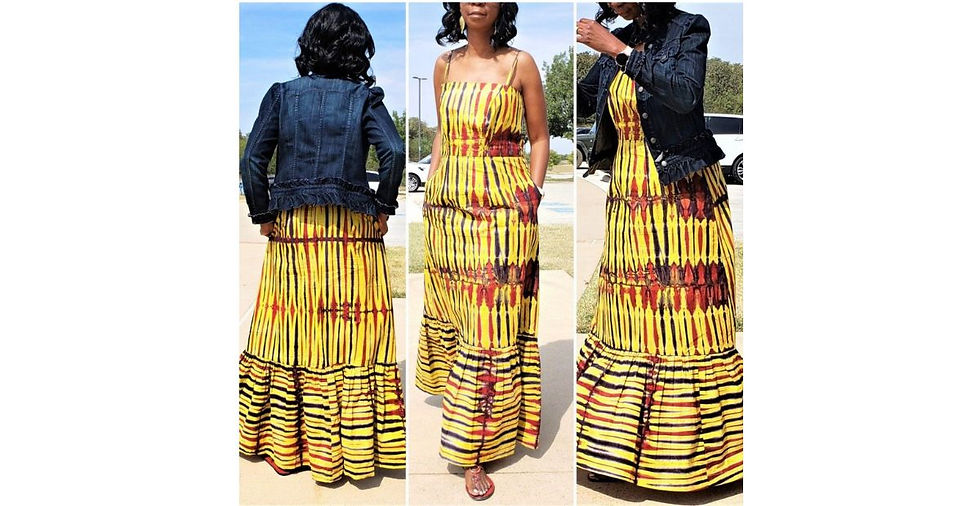
How to Style a Kente Dress
If you're wearing a Kente dress, the fabric is already doing a lot of visual work.
You don't necessarily need to pile on accessories.
A simple approach can work beautifully.
Try pairing a colorful Kente dress with:
Gold earrings
Simple heels
A neutral clutch
Minimal makeup
A clean hairstyle
For a more traditional appearance, you can add:
Beaded jewelry
Headwrap
Gold accessories
Traditional sandals
The key is balance.
If the dress is heavily patterned, let it remain the star.
How to Style Kente for Men
Men can incorporate Kente into both traditional and contemporary outfits.
Some options include:
Kente Shirt
A Kente shirt can be paired with neutral trousers.
Kente Blazer
A Kente blazer can transform a simple black or white outfit into a statement look.
Kente Details
You don't need an entire Kente outfit. A pocket square, tie, collar, or vest can introduce the fabric more subtly.

Traditional Kente Outfit
For cultural events, traditional Kente draping or a tailored traditional ensemble can create a more formal appearance.
Kente vs. Ankara: What's the Difference?
People sometimes use the terms interchangeably, but Kente and Ankara are not the same thing.
Kente is traditionally a woven textile associated particularly with Ghanaian cultures.
Ankara generally refers to printed wax-style textiles widely used across West African fashion.
The production methods are different.
Kente is created through weaving.
Ankara is generally produced through printing.
They also have different cultural histories.
Both are important African textiles, but they shouldn't be treated as identical.
Is Kente Only From Ghana?
Kente is most strongly associated with Ghana, particularly the Asante and Ewe traditions.
However, there are different Kente weaving traditions, and the textile's cultural history is more complex than simply saying "Kente belongs to one group."
The Ewe communities of Ghana and neighboring regions have their own distinctive Kente traditions.
This is worth remembering because African textile history is often much more nuanced than simplified descriptions suggest.
Authentic Kente vs. Kente-Inspired Fabric
This distinction is crucial as Kente becomes more globally recognizable.
Not all Kente are hand-woven Kente.
You might see:
Traditionally handwoven Kente
Or
Traditionally woven textile using established weaving techniques
You might also see Kente-inspired fabric.
Neither are automatically “bad.”
They are just different.
If your concern is with culture and tradition, enquire about the methods and means of production of the fabric.
Kente Fashion Ideas for Everyday Wear
You don't have to wait for a wedding or graduation to wear Kente.
Small amounts of Kente can work surprisingly well in everyday fashion.
Try:
Kente blazer + black trousers
A sophisticated combination for work or dinner.
Kente skirt + plain blouse
Let the skirt provide the color while keeping the top simple.
Kente shirt + jeans
A relaxed way to introduce traditional textile into casual clothing.
Kente handbag + neutral outfit
Perfect if you want something subtle.
Kente headband + simple dress
A small cultural detail can make a big difference.
The secret is not overcomplicating things.
Sometimes one Kente piece is enough.
Wrapping it up
Kente has survived because it has never been just about appearance.
It carries history.
It carries craftsmanship.
It carries identity.
It carries stories.
From the royal courts of Ghana to modern weddings, university graduation ceremonies, cultural festivals, fashion runways, and everyday wardrobes, Kente continues to evolve.
Its colors attract attention, but its deeper meaning is what makes it special.
When you see a piece of Kente, you're looking at more than a colorful textile.
You're looking at the work of a skilled weaver.
You're looking at a tradition passed through generations.
You're looking at patterns that can communicate ideas.
And you're looking at a textile that has become one of the most recognizable representations of Ghanaian and African cultural heritage around the world.
Whether you choose to wear a full traditional Kente outfit, a modern Kente dress, a blazer, a graduation stole, or simply a small Kente accessory, understanding the story behind the cloth makes the experience that much richer.
Because the beauty of Kente isn't only in the colors.
It's in the story woven into them.


Comments